
By Leo Wei, Founder and Director · Published
What an Airbnb income calculator gets right, and three things it cannot know
The nightly rate these tools give you is usually close. The yearly figure built on it assumes a calendar most Sydney properties are not permitted to run. Here is the arithmetic, using the calculator's own numbers.
Are Airbnb income calculators accurate?
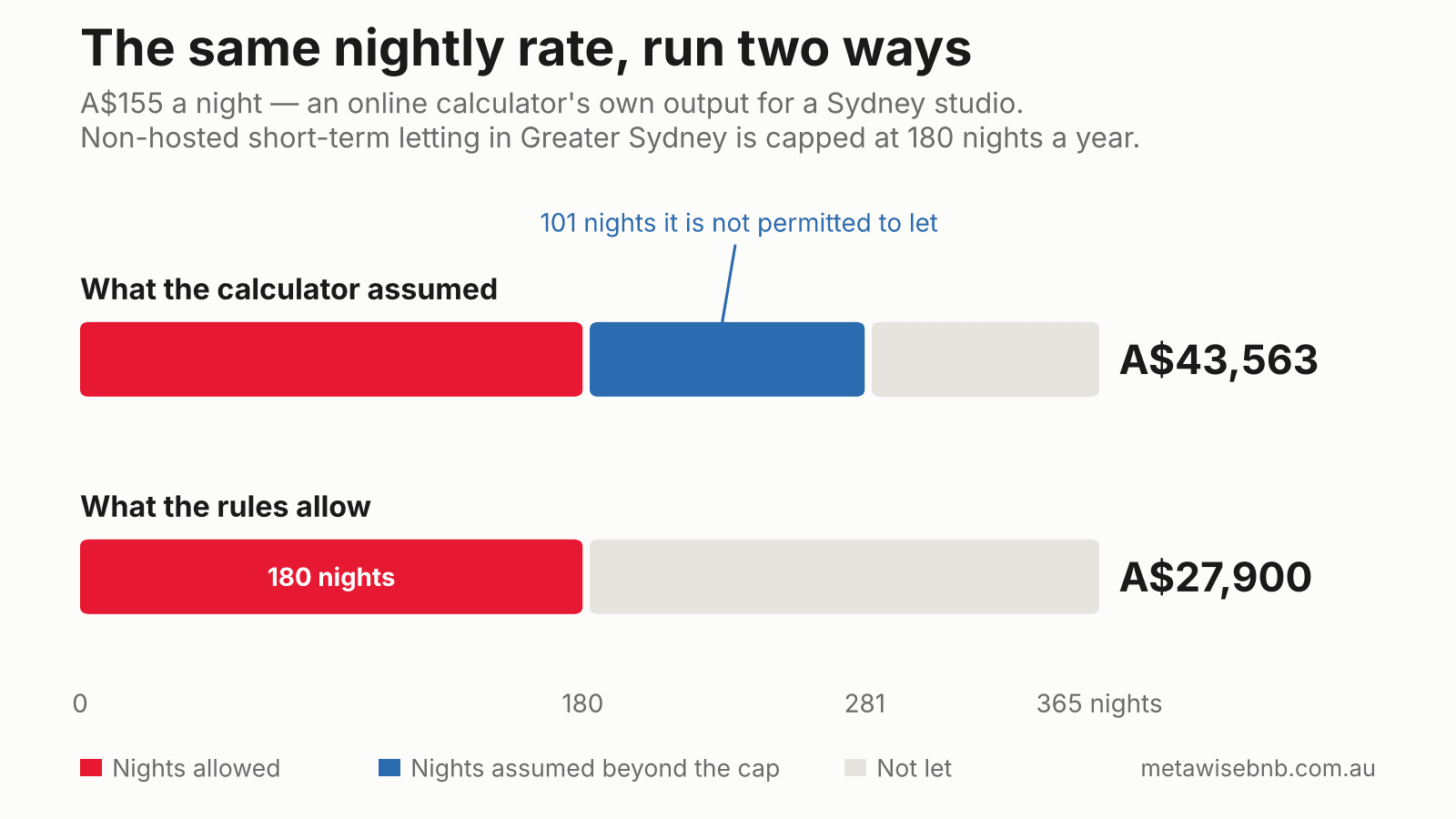
On the nightly rate, usually yes — they read asking prices from listings near your address, and for a Sydney property that gets close. The yearly figure is a different matter. A calculator output for a Sydney studio — A$155 a night at 77% occupancy — produces A$43,563 a year, which assumes 281 nights of letting. Non-hosted short-term letting in Greater Sydney is capped at 180 nights, and at the same nightly rate that is A$27,900. The gap is about A$15,600, and it exists before you have taken a single night for yourself.
What these tools do well
Owners arrive with a number from an online calculator more often than not. It is usually the first number they have seen, and it sets what they expect from everything after it.
Tools of this kind — AirDNA, Mashvisor, and the free calculators most management companies run — work the same way. They read asking prices and availability from listings near your address and build an estimate from them.
Give them credit for what they are good at: the nightly rate. Asking prices across enough nearby listings really do get you close to a market rate for a Sydney property, and anyone who tells you these calculators are simply made up is not being fair to them.
We do not publish our owners' figures — their income is theirs, not marketing material for us. So there is nothing below you have to take on trust. Every number is either the calculator's own output or the legislation, and you can carry each step through yourself with the figures already in front of you.
It cannot know which occupancy it is quoting you
This is the one that does the most damage, and it is hiding in a single word.
You do not have to take our word for what it means. AirDNA defines its occupancy rate on its own calculator page as booked nights divided by nights available — not booked nights divided by the year. An owner reads 77% as nights sold against the year. Those are different numbers, and the second is always smaller.
The gap between them is not a market fact. It is the sum of a lot of individual decisions by other owners about how much of the year to make available — people who blocked out January, or who only let in summer, or who stopped for three months to renovate. None of those decisions are yours, and none of them are visible in the figure you were handed.
So the first question to ask of any occupancy number is simply: against what? If nobody can tell you, the yearly figure built on it does not mean anything in particular.
It cannot know how much of the year you want
A calculator gives you a market figure. Your income is a market figure minus your life.
Suppose you want the place for a month — a stretch over summer, or while family are visiting. That month sells nothing, and nothing has gone wrong; you wanted your own home, which is a perfectly normal thing for an owner to want. It is also roughly a twelfth off the year, and no calculator deducted it.
This is worth being clear about, because it is easy to read as a warning and it is not one. Blocking out your own dates is a decision made at the start, not an accident that happens to you — the weeks go in the calendar before a property goes live, and the rest of the year is priced around them.
What you cannot do is take a figure built on other people's calendars and assume it survives your own plans. Two weeks at Christmas and a fortnight in winter is a month of the year, and a month is not a rounding error.
It cannot know about the 180-night cap
This one is specific to Sydney, and it is the largest of the three.
Non-hosted short-term letting in Greater Sydney is capped at 180 nights a year. Bookings of 21 nights or more sit outside that count. AirDNA describes its projection as running over twelve months assuming full availability for 365 days, which is the assumption the cap contradicts. To be fair to them, these tools increasingly surface local rules alongside the estimate — AirDNA has a feature that does exactly that. What we have not seen is a tool that takes the night limit off the revenue figure itself. The rules arrive next to the number, not inside it.
Take the output for a Sydney studio and watch what happens. A$155 a night at 77% occupancy is A$43,563 a year. That figure assumes 281 nights of letting. The rules allow 180.
At the same nightly rate the calculator itself gave you, 180 nights is A$27,900. The difference is about A$15,600, and it is there before anyone has taken a night for themselves, had a quiet week in August, or paid a cleaner.
| What the calculator assumes | What the rules allow | |
|---|---|---|
| Nightly rate | A$155 | A$155 |
| Nights let | 281 (365 × 77%) | 180 |
| Yearly figure | A$43,563 | A$27,900 |
Which does not mean the number is out of reach
Here is the part worth understanding, because the cap is not the end of the story.
Stays of 21 nights or more do not count toward the 180, so they sit on top of it. In our experience they price somewhat below nightly stays — you are trading rate for certainty — but they fill weeks that nightly letting cannot legally take, and they fill them without a changeover every third day.
A calendar built that way can get close to the figure the calculator produced. It arrives by a completely different route, and it leaves a meaningful part of the year free for the owner.
That is the honest answer to whether the number is reachable. Often it is. The route the calculator implies is not the route that reaches it, and the route that does is a mixed calendar somebody has to actively run.
What to do with the number you are holding
Keep it, and use it for the nightly rate, which is the part it does well.
Then ask three questions of the yearly figure, in this order. Against what is that occupancy measured — the year, or the nights somebody chose to open? How many nights do I want the property for myself? And does this figure respect the 180-night cap, or has it quietly assumed 365 nights of letting?
Those three will move the number further than any argument about the nightly rate. You can do all of them on the back of an envelope with the figures you already have.
What we do instead
We do not send a single figure. We send a range with the assumptions written next to it, and we would rather tell an owner the honest answer is lower than let them furnish a property against a number we knew was optimistic.
Before any of that we check three things a calculator cannot: whether the building and its by-laws permit short-term letting at all, how many nights of the year you want for yourself, and how the cap and longer stays fit together for your property specifically.
The first of those sets your income to zero if the answer is no, and it is the cheapest thing to check. We check it before anyone spends money on furniture.
Common questions
- Does AirDNA work in Australia?
- Yes, and so do the others. Coverage is not the problem. The nightly rate these tools produce for a Sydney address is usually close. The weakness is everything built on top of that rate, particularly the annual figure, which assumes a calendar most Greater Sydney properties are not permitted to run.
- Why is my estimate different from a neighbour's in the same building?
- Usually because the tool is reading a different set of nearby listings, and sometimes because one apartment genuinely earns more. Two units in one building can be a long way apart on aspect, car space and how many people can sleep there comfortably. A calculator reading the street cannot see any of that.
- Does the 180-day cap change the estimate?
- It should, and it does not. Non-hosted short-term letting in Greater Sydney is capped at 180 nights a year, and bookings of 21 nights or more sit outside that count. Some tools surface local rules next to the estimate — AirDNA has a feature for it — but we have not seen one take the night limit off the revenue figure itself. On a A$155 nightly rate that alone is the difference between A$43,563 and A$27,900 before any other deduction.
- So should I ignore the number a calculator gives me?
- No. Keep it and use it for the nightly rate, which is what it is good at. Then ask what the occupancy is measured against, how many nights you want for yourself, and whether the 180-night cap has been applied. Those three questions will move the yearly figure further than any argument about the rate.
This article uses a calculator output for a Sydney studio and the rules as we understand them at the time of writing. It is general information, not financial, tax or legal advice, and it is not a forecast for any particular property. Short-term rental rules in NSW change; check the current position before making a decision.